A mint next to the mother lode
By the mid-1860s, the Comstock Lode was pouring silver out of the Nevada mountains faster than it could be safely handled. Shipping raw bullion over the Sierra Nevada to the San Francisco Mint was slow, expensive, and an open invitation to bandits. Nevada's answer was audacious: build a branch of the United States Mint right at the source. Congress agreed, and in 1866 construction began on a sandstone fortress in Carson City, just a wagon ride from the mines themselves.
The driving force was Abraham Curry, a founding father of Carson City so central to the project that he became the mint's first superintendent. The stone came from the state prison quarry; the ambition came from the frontier itself. In early 1870, the Carson City Mint struck its first coin, a Seated Liberty silver dollar, and the "CC" mint mark entered American history.
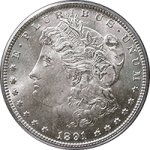
Small mintages, giant legend
Carson City was never a volume operation. Compared to Philadelphia or San Francisco, its output was tiny: the mint ran only from 1870 to 1885, then again from 1889 until coining ended for good in 1893. It struck Seated Liberty coinage, Trade Dollars, gold eagles and double eagles, and, from 1878 onward, the Morgan Silver Dollars that would carry its fame into the next century.
Those modest mintages are exactly why collectors revere the CC mark today. Nearly every Carson City issue is scarce by birth, and several are legendary: the 1889-CC Morgan, rarest of all CC dollars; the 1893-CC, struck in the mint's final year; and the 1873-CC "No Arrows" dime, known from a single surviving example that anchored the Eliasberg Collection.
The vault that time forgot
When Carson City's presses stopped, millions of its silver dollars simply stayed put, sealed in Treasury vaults, untouched and uncirculated, for the better part of a century. Their rediscovery in the 1960s stunned the numismatic world: whole bags of gleaming, mint-fresh CC Morgans that had never bought so much as a cup of coffee.
Between 1972 and 1980, the General Services Administration sold those vault-fresh Carson City dollars to the public in the government's famous black display cases with certificates. An original GSA-holdered CC Morgan, still in its government packaging, remains one of the most satisfying finds in the hobby: a coin from an Old West mint, preserved by the government that struck it.
Still standing, still striking
The mint building never went away. After coining ended in 1893, it served as a federal assay office until 1933, and today the sandstone fortress on Carson Street houses the Nevada State Museum. Remarkably, the mint's original Coin Press No. 1 survives inside it, and the museum still fires it up for demonstration strikes. The machine that coined the treasure of the Comstock is, a century and a half later, not quite finished.
For collectors, every coin bearing those two small letters is a document of the frontier: proof that for twenty-three years, the American West minted its own money.